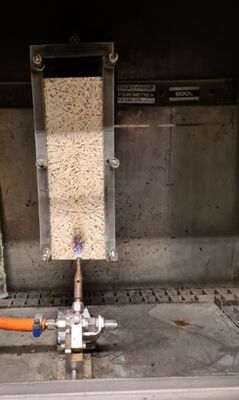
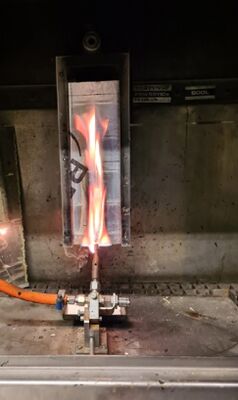
The role of EN ISO 11925-2:2020 test in the European Classification System
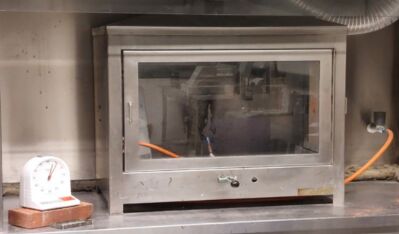
EN ISO 11925-2:2020 Ignitability of products subjected to direct impingement of flame - test for flammability of building materials - part II: test for single fire source. The required results are E-B grade (combined with the test results of EN 13823) and Efl - Bfl grade (combined with the test results of EN ISO 9239-1).
Testing principle
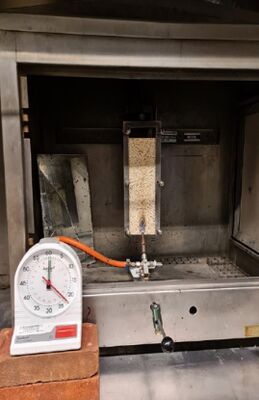
This test determines the flammability of the sample in the vertical direction when it encounters a small flame at the edge or surface of the sample. Observe the burning behavior of the sample to see if the flame spreads and if there are any burning particles or droplets.
Test report
The test report contains information about the sample and the test results. The test report contains the following information:
● The exposure time used for the test (15 or 30 seconds);
● Exposure mode (edge - surface);
● Whether the top of the flame reaches and/or passes through the mark 150 millimeters above the flame ejection point, and the exact time of reaching and/or passing through the mark;
Have you observed that the burning droplets ignited the filter paper in the tray below the test sample?
The criteria for assessment in accordance with EN 13501-1
The above test results can be used for classification assessment in accordance with EN 13501-1. Under normal circumstances, the evaluation is based on the average of 6 to 12 tests. For D-B grades, exposure for 30 seconds is required, and the flame height must not exceed 150 millimeters within 60 seconds after the test begins.
For the (other) categories (E and Efl), exposure for 15 seconds is required, and the flame height should not exceed 150 millimeters within 20 seconds after the test begins. For floor classification and end uses where edge exposure is not possible, only surface exposure is carried out. In all other cases, edge exposure should also be carried out in addition to surface exposure.
Test sample
The sample should represent the final use of the product as much as possible. This is particularly applicable to the use of standard substrates described in EN 13238.
A basically flat sample should be used:
● Dimensions: 250mm x 90mm
● Thickness: Maximum 40 millimeters (including the substrate at the time of use)
Product standards for specific products (groups) may include provisions on sample structure to achieve the maximum application range.
It can provide guidance for more product samples. After the order is confirmed in writing and the samples are debugged according to the standards, the testing can begin.
Additional tests for multi-layer specimens
For multi-layer specimens with a thickness greater than 10 millimeters, only single-layer specimens with a thickness greater than 3 millimeters (except for adhesive layers) need to undergo additional flame impact tests.

 Your message must be between 20-3,000 characters!
 English