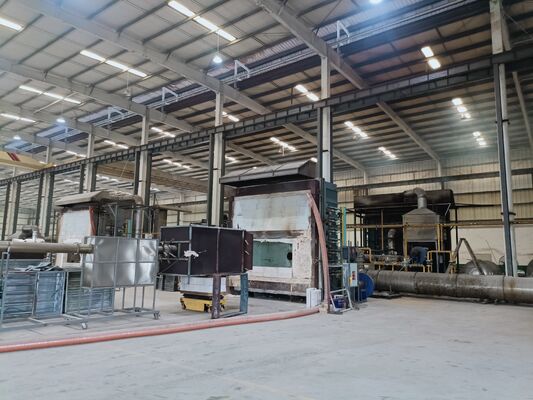
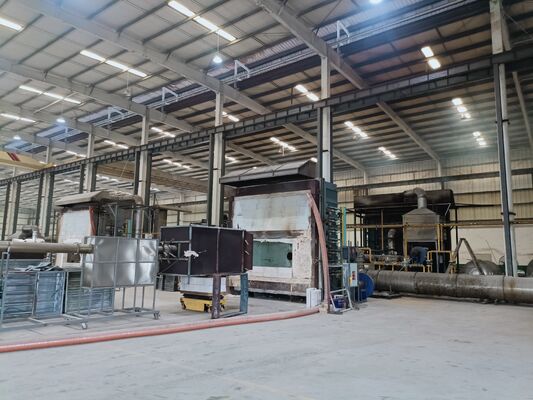
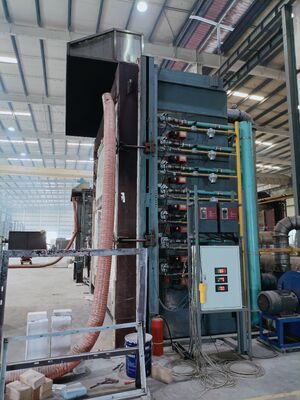
Building Material Fire Resistance Test Furnace

Test scope:
1. The fire zone on one side is a reinforced concrete load-bearing wall with a thickness of 3000 (mm), a steel structure load-bearing wall with a protective layer (fireproof coating) for fire resistance, and materials such as light steel keel load-bearing walls and laminated wood load-bearing walls. Determine the temperature of selected points within the wall with different cross-sections and widths.
2. Fire resistance testing of non reconfigurable attachments. Intelligent testing device for fire resistance performance of non load bearing walls
The net size inside the furnace is 4200 × 4008 × 1500 (mm), and the specimen fire area is 4200 × 4800 (mm)
Test scope: It can simultaneously test the fire resistance performance of symmetrical and asymmetrical structural samples under the same working conditions, such as fireproof doors and windows, glass, fireproof materials, etc. It can also conduct fire resistance tests on large fire compartments and fire partition components (such as large-area firewalls), fire-resistant glass partitions, fire-resistant rolling shutters, with high efficiency. It can test several different or similar samples simultaneously.
3. Intelligent testing device for fire resistance performance of load-bearing columns
The net size inside the furnace is 3000 × 3000 × 4700 (mm), and the height of the specimen under fire is 3000-4600 mm (the total height of the column is 3600-5200 mm). The maximum cross-sectional size of the sample is 800 millimeters by 800 millimeters or Φ 800 millimeters.
The total axial load is 15000kN, and the upper and lower eccentric loads are both 1000kN.
Test scope:
1. Conduct fire resistance tests on reinforced concrete columns with a height of 3600-5300 millimeters and a fire resistance height of 3000-4700 millimeters, and withstand single and multiple composite loads of various cross-sectional shapes and sizes.
2. Fire resistance performance testing of steel structural columns with protective layers (fireproof coatings) of various cross-sectional shapes and sizes, with column heights ranging from 3600 to 5300 millimeters and fire heights ranging from 3000 to 4700 millimeters, capable of withstanding single and multiple composite loads.
3. Temperature measurement at selected measurement points of different cross-sections and depths inside the column.
4. Fire resistance test for other items (such as safes) exposed to fire on all sides.
Intelligent testing device for fire resistance performance of fire doors. The configuration we provide below is for reference only;
Scope of application: Suitable for load-bearing and non load-bearing components such as walls, beams, columns, floors, ceilings, roofs, etc. Other components, attachments, or structures can be referenced and adopted. This testing machine is suitable for testing all components of GB/T9978.1-9 and ISO834-1-9 standards.
Compliant with standards: GB/T9978.1-2008, GB/T9978.2-2008, GB/T9978.3-2008 "Fire resistance test methods for building components - Part 1: General requirements", ISO834-1-1999 "Fire resistance test for building components - Part 1: General requirements"
Main parameters:
Laboratory: 4.5M (length) x 4.5M (width) x 3.5M (height), using high-temperature insulation materials indoors.
Loading device: Mechanical loading is used to move bridge cranes inside buildings. It can simulate uniform loading, centralized loading, axial loading, or eccentric loading.
Support frame: a wedge-shaped bracket connected to the frame through four rollers.
Thermocouples: including furnace thermocouples, tempering thermocouples, mobile thermocouples, internal thermocouples, environmental temperature thermocouples distributed in various regions, etc.
Furnace pressure measuring probe: T-shaped measuring probe with a measurement accuracy of ± 2Pa
Test piece gap measurement probe: ± 0.1 mm with a diameter of 6 mm and ± 0.2 mm with a diameter of 25 mm
Combustion system: valve system (within 10 meters), nozzle (not less than 20), regulating valve
Combustion gas source: propane with a purity of over 95%, liquefied gas (provided by the user)
Gas flow rate: 0-100L/min, measurement accuracy level 2.5
Air flow rate: 0-50m³ /min, Measurement accuracy ≤± 0.5m³ /Minutes
Storage tank capacity: ≥ 50 kg x 6
Furnace temperature control system: maximum 10 sampling points
Ventilation system and control air valves, etc
Measurement range of radiant heat on the back surface of the sample: 0~10 W/cm ²
The temperature and pressure control inside the furnace are connected to the control system through RS485 of the computer. The DC output voltage of sensors used for combustion testing, such as thermocouples and pressure sensors, is converted into digital form and then transmitted to a computer system for display and storage.
Note: The specific implementation of the fire resistance testing device for building components should be based on the products that customers need to test to avoid unnecessary costs. For example, the Tianjin Fire Research Institute of the Ministry of Public Security has five different fire resistance testing instruments for building components, including intelligent testing devices for fire resistance performance of load-bearing beams and slabs, intelligent testing devices for fire resistance performance of load-bearing walls, furnace net dimensions of 3000 × 3000 × 1500 (mm), specimen fire zone of 3000 × 3000 (mm), and a total bearing capacity of 2000kN.
Vertical furnace:
Scope of application: Suitable for determining the fire resistance characteristics of horizontal building components such as walls, beams, columns, floors, ceilings, etc. under standard fire conditions.
Compliant with standards: GB/T9978.1-2008,ISO834-1:1999,GB/T9978.5-2008,ISO834-5:200,GB/T9978.6-2008,ISO834-6:200 Waiting for testing requirements.
Performance features: The high-precision multi bit acquisition card is used to collect various data such as temperature, pressure, and flow rate for each channel. Real time reproduction of real information generated during the combustion process through microcomputer analysis, processing, and control, and determination of its combustion characteristics through microcomputer analysis. The whole machine is equipped with high-quality devices to ensure high-quality, high-speed operation and progressiveness of the system.
Technical Specifications:
1. Instrument composition: refractory material testing furnace, gas flow measurement system, temperature measurement system, pressure measurement and control system.
2. Refractory material testing furnace: It is a vertical testing furnace with internal dimensions of 4.5m (length) x 3.5m deep x 1.25m high.
3. Furnace structure: Steel structure frame is adopted, and the furnace wall is constructed with refractory bricks in the middle of the steel structure frame. The inner side of the furnace wall adopts a density greater than 1000kgpm³ The heat-resistant insulation material. The outer side is wrapped in color steel, and the thickness of the furnace lining material is 65 millimeters. The temperature test inside the furnace can reach 1250 ℃.
4. Temperature measurement system:
1. In furnace thermocouple: K-type nickel chromium thermocouple with a wire diameter of 2.0 millimeters in accordance with GB/T 16839.1 is used in the furnace. The outer cover is made of heat-resistant stainless steel tube sleeve, and the middle is filled with heat-resistant material. The length of the hot end protruding from the sleeve is not less than 25 millimeters, with a total of 5 thermocouples and a temperature accuracy of<± 15 ℃.
2. Measurement of tempering surface temperature: Use a thermocouple with a diameter of 0.5 millimeters, which is welded to a circular copper plate with a thickness of 0.2 millimeters and a diameter of 12 millimeters. Large nickel chromium nickel silicon thermocouples that comply with GB/T16839.1 should be covered with asbestos pads with a thickness of 2.0 millimeters and a length and width of 30 millimeters. There are a total of 20 items.
3. Average temperature measurement: 8 thermocouples, suitable for GB/T7633-2008 and GB/T17428-2009
4. Maximum temperature measurement: Measure 20 thermocouples for double door panels, with molded door panels covering a maximum width of 1200 millimeters.
5. Mobile thermocouple: measured using an infrared thermometer
6. Internal thermocouples: There are 4 thermocouples suitable for measuring the internal temperature of ventilation ducts.
7. Environmental temperature measurement: Armored thermocouples with a diameter of 3.0 millimeters and large nickel chromium nickel silicon K-type thermocouples are used, in accordance with the provisions of GB/t16839.1.
8. Furnace pressure measurement: Use a T-shaped measuring probe with a measurement accuracy of ± 2pa
9. Loading system: Measure using pressure sensors
10. Deformation measuring instrument: using electronic deformation measuring device
11. Gap probe: manufactured according to GB/T9978.1 standard
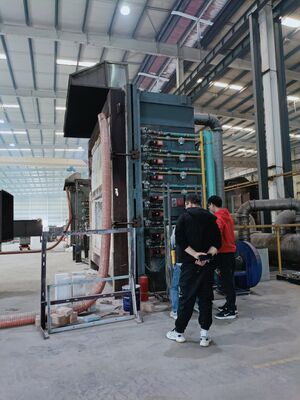
12. Burner: There are 8 high-speed burners embedded in the furnace walls on both sides, with 6 on each side. Provide the heat required for the heating furnace.
13. Smoke exhaust: There are three smoke exhaust holes installed on the rear wall of the furnace, which are connected to the rear flue to exhaust the smoke inside the furnace. Control pressure.
14. Observation holes: There are two observation holes on the back wall of the furnace body, which are used to observe the fire surface and flame of the sample during the test process.
15. Loading device: Using a trolley, with a height of 3.5m and a width of 3.0m, consisting of a vehicle body and a specimen platform. The vehicle is designed with four ground wheels that can move on rails. The experimental platform is a 3.0m × 3.0m square steel structure frame. During the experiment, an electric hoist is used to lift the specimen platform onto the vehicle body, then the small car is pushed to the testing position and fixed before starting the experiment.
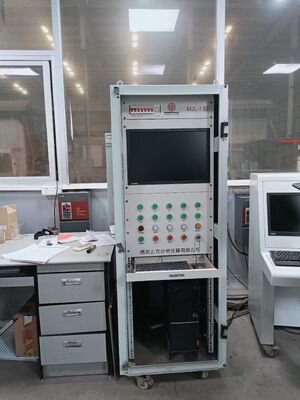
16. Electrical control part: MCGS configuration software and PLC program integrated with chemical control computer are used.
Including: main control interface, furnace temperature curve interface, sample temperature interface, historical record interface, parameter determination interface.
Our services
1. Ensure the high quality of the product.
2. Packaging can be customized according to customer requirements, and pictures can be attached before shipment.
3. Transportation professional documents
4. Provide professional product consultation before sales, and we guarantee to answer any technical questions you may encounter within 48 hours; Provide timely product technical services after sales and provide solutions within three working days.
5. Our engineers provide professional after-sales service
6. The warranty period is 12 months. During the warranty period, we are responsible for providing free maintenance, upkeep, and replacement of damaged and defective parts (under normal use) for the user's equipment. After the free warranty ends, the service fee will be charged at your own discretion.
7. Provide the fastest response to user maintenance and assistance requests. After users submit maintenance requests, ensure that professional technical support is provided in the shortest possible time and as quickly as possible.

 Your message must be between 20-3,000 characters!
 English