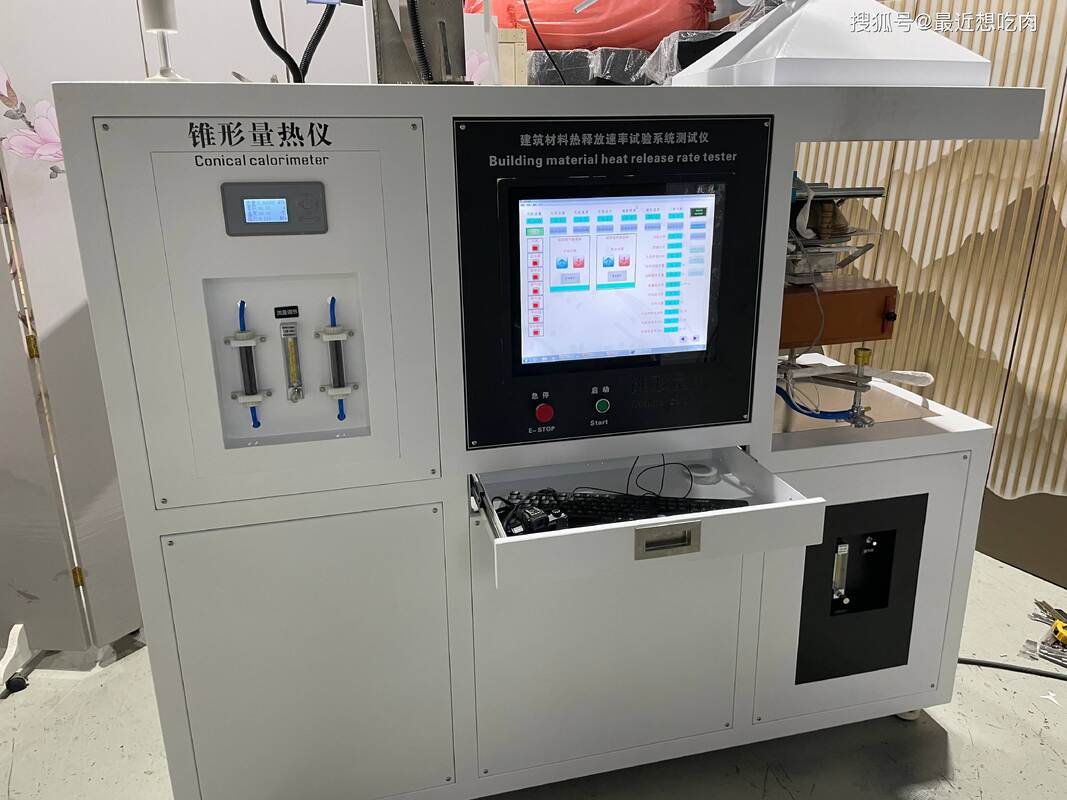
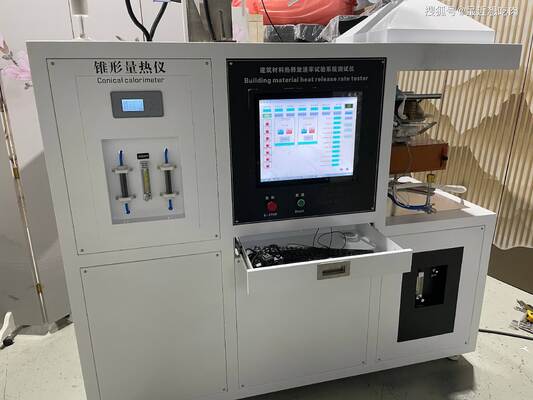
DX8348 Cone Calorimeter: Used to test material combustion performance, heat release and fire safety parameters

Purpose
The DX8348A Cone Calorimeter is mainly used for accurate testing and evaluation of the combustion properties of building materials. By simulating a real fire environment, it quantitatively measures key parameters such as heat release rate, total heat release, and mass loss rate of materials under controlled thermal radiation, providing scientific and reliable experimental data support for the fire safety rating of building materials, optimization of flame-retardant formulas, and fire engineering design.
Scope of Application
This instrument strictly complies with the national standard GB/T16172-2007 and international standard ISO5660-1:2002. It is applicable to various building materials, including but not limited to thermal insulation materials, decorative panels, coatings, fabrics, foamed plastics, composite panels, etc. It is widely used in fire detection institutions, building material manufacturers, research institutes, universities, and third-party testing laboratories for research on flame retardant performance and quality inspection of materials.
Key Features
1. Modular flexible configuration: The equipment adopts a modular design, allowing users to select and install optional modules such as flue gas analysis, toxic gas (CO, CO₂) analysis, and smoke release rate according to testing needs, realizing comprehensive testing from basic heat release to complex flue gas toxicity.
2. High-precision automatic ignition system: Equipped with a high-voltage spark generator that supports automatic positioning ignition, ensuring accurate and stable ignition positions, avoiding manual operation errors, and guaranteeing the repeatability and reliability of experimental results.
3. Multi-dimensional data output: It can fully record and output core data such as ignition time, average heat release rate within 180s-300s after ignition, total heat release, mass loss rate, radiation intensity, exhaust volume, and heat release rate-time curve, comprehensively reflecting the combustion behavior of materials.
4. Adjustable exhaust and temperature control system: The exhaust flow can be precisely adjusted between 0.012m³/s and 0.035m³/s. The cone heater has a maximum power output of ≤5KW and a heat radiation intensity range of 0~120KW/m², which can simulate thermal environments of different fire intensities to meet diverse testing scenarios.
5. Stable and reliable gas analysis capability: Standard with a paramagnetic oxygen analyzer (concentration range 0-25%), optional infrared analyzers for real-time monitoring of CO (0-1%) and CO₂ (0-10%) concentrations, accurately capturing changes in gas components during combustion.
Core Characteristics
1. Conical heating structure design: The heater is designed in a 45° conical shape with a stable and controllable flame height (20mm), which can uniformly radiate heat to the sample surface, simulating the real process of material thermal decomposition in a fire.
2. High-precision timing and measurement: The timing resolution reaches 1 second with an error of <1s/n, which can accurately capture the moment of material ignition; the maximum sample box size is 100mm×100mm×50mm, adapting to common building material sample specifications.
3. Stable combustion environment control: The overall dimensions of the equipment are 1.68m×0.686m×1.92m, with a total weight of 350Kg. The stable structure provides a stable environmental condition for combustion testing and reduces external interference.
4. Standardized operation and data traceability: All testing procedures and data collection comply with international and domestic standards, ensuring that experimental results are traceable and comparable, meeting the requirements of laboratory certification and quality systems.

 Your message must be between 20-3,000 characters!
 English