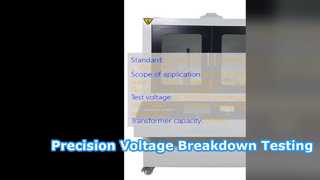
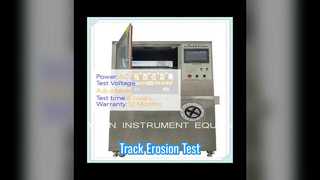
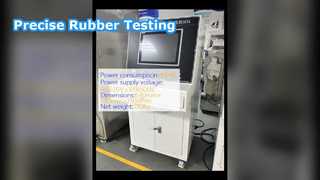
Brief: We tested it—see the highlights and what to expect in real operation. This video provides a detailed walkthrough of the Silicon Rubber Rotorless Rheometer, demonstrating how it analyzes scorch time, vulcanization rate, and viscoelastic modulus during rubber processing. You'll see the instrument's precise temperature control and data reporting capabilities in action, showcasing its application for product development and quality control according to international standards.
Related Product Features:
Features a real closed mold cavity design, ensuring repeatability and data comparable to industry leaders like Alpha.
Utilizes a large-scale database development platform with software-controlled temperature for precise data collection and processing.
Meets international standards including GB/T16584, ISO6502, and Italian standards for T10, T30, T50, T60, T90 data.
Offers comprehensive reporting of ML, MH, ts1, ts2, t10-t90, vulcanization curves, and temperature curves.
Provides precise temperature control with a range of 0-200°C and fluctuations within ±0.1°C.
Includes statistical, analytical, storage, and comparison functions with a user-friendly, easy-to-operate design.
Equipped with a torque range of 0-20N.m and a swing frequency of 1.7Hz for accurate viscoelastic modulus measurement.
Designed with a Monsanto-form cavity structure, leading the international industry in performance and reliability.
Faqs:
What standards does this rotorless rheometer comply with?
It meets GB/T16584, ISO6502, and Italian standard requirements for T10, T30, T50, T60, T90 data, as well as ASTMD5289-95 and ISO6502:1991.
What key rubber properties can this equipment measure?
It analyzes scorching time, positive vulcanization time, vulcanization rate, viscoelastic modulus, and the vulcanization flat period during the rubber curing process.
How precise is the temperature control of this rheometer?
The temperature control range is 0-200°C with a fluctuation of only ±0.1°C and a display resolution of 0.1°C, ensuring highly accurate test conditions.
What are the main applications of this testing instrument?
It is used for developing new rubber products, studying rubber formulations, and inspecting product quality, as specified by national standards for quality control.